 Caleb Hailey
@calebhailey.com
Caleb Hailey
@calebhailey.com
There's a feeling you get when you are building something that you're very passionate about that can haunt you if you let it: "What if someone else makes something [similar / better / faster]?" It's a particular brand of imposter syndrome that will be familiar to anyone who has ever written1 an "Introducing X" blog post or tweet.
I just published one such blog post this morning, announcing the launch of @hypertexting.com for iPhone on the App Store. 🎉 It's exciting and scary at the same time. But it almost didn't happen.
I have never felt the aforementioned fear more acutely than this past January when Terry Godier (@terrygodier.com) published an essay called "Phantom Obligation":
Why do RSS readers look like email clients?
If you've used almost any RSS reader in the past two decades, you know this layout intimately. There's a sidebar with your feeds organized into folders. There's a list of items, sorted by date, with little dots indicating what you haven't read yet. There's a reading pane where the content appears when you click.
The shape is so ubiquitous that it feels inevitable. But of course nothing in design is inevitable. Someone made a choice, and then other people followed that choice, and eventually the choice calcified into convention.
As I read the rest of Terry's thoughtful blog post, I experienced simultaneous surges of joy and dread. 🎢 Never before had a single blog post captured so much of my feelings about a technology that I have spent so much time thinking about (RSS). I was practically hugging my laptop as I read it.
And then the dread:
I built an RSS reader with these principles. If you're interested, you can check it out now.
Did Terry beat me to it? Did the project I had been working on for over a year just become an afterthought? Thankfully, it turns out that Terry and I made very similar observations, but those observations inspired very different products.
To be clear, I agree with every single word in Phantom Obligation. But I also think the opportunity for RSS readers is much bigger than solving the unread count problem. Allow me to explain.
The Outlook-like interface
Pull up a chair kids, because "back in my day..." I remember when NetNewsWire came out (still the 🐐 IMO) and the hottest buzzword in tech wasn't "AI", it was "the Outlook-like interface". 🤣 During the early-mid 2000's I worked in tech support at a small software company (my first tech job) and the founder was obsessed with making our app(s) look like Microsoft Outlook. It drove me absolutely crazy. I wouldn't understand why that mattered until later in my career as a Product Manager. It was about meeting people where they were. The "Outlook-like interface" was just an earlier iteration of "Uber for X".
Outlook wasn't "intuitive", but it was familiar to a LOT of people. Today there's nothing more familiar than the social media news feed. On September 5th, 2026 the Facebook News Feed will turn 20 years old! Even though it didn't invent the feed, that launch marked a seminal moment in internet culture history as it shaped much of how we experience the internet down to this day. It's all feeds, all the way down.
The social-media-like interface
For the past few years I've spent an inordinate amount of time thinking about whether a "social-media like interface" is possible for "RSS" (and Atom, and JSON Feed, and OPML). The conclusion I've reached is that this requires more than just a departure from the three-column/inbox-style feed reader and obligation-inducing unread counts. It means taking inspiration from social media profiles, responses, mentions, threads, video, discovery, and even personalization. It also means embracing user privacy and the unique attributes of the open web that social media platforms can't refuse to give us. Finally, it should also lower the barrier to entry for publishing in addition to subscribing.
Executing on that thought process over the past year is what led me to HyperTexting. I hope you will try it, and I hope it helps you escape the algorithm.
Oh, and there's one more thing.
Talking about RSS without saying "RSS"
RSS is a tremendous success story. Without it, the expression "Wherever you get your podcasts" would not be possible. And yet it is! But why has podcasting reached escape velocity in a way that "RSS readers" have not? Why don't more people know that RSS readers are a compelling alternative to algorithmic social media newsfeeds? Is it a branding problem, a product problem, or something else?
I think the answer is much bigger and more complicated than Current or HyperTexting. I also think we can get there by starting small. In order for RSS to succeed reach escape velocity, I think we need to stop saying "RSS".2 That's why, if you look closely, you'll see that I've gone out of my way to avoid using terms like "RSS", "Atom", "JSON Feed" or "OPML" in the HyperTexting app and website.
I hope this part of the HyperTexting experiment works, and even more so, I hope it inspires my fellow RSS advocates to keep building! Don't let the imposter syndrome win!
I built an RSS reader with these principles. If you're interested, you can check it out now. 😊
-
I emphasize the writing here because I suspect there are thousands if not millions of "Introducing X" blog post drafts and abandoned Tweets resulting from letting the imposter syndrome win. Hitting "Publish" requires a certain kind of courage! ↩︎
-
Hi Dave. 👋 I see you and I'm a huge fan! I suspect you may have thoughts™ on this take, but I think it's possible we might agree more than we disagree. ↩︎
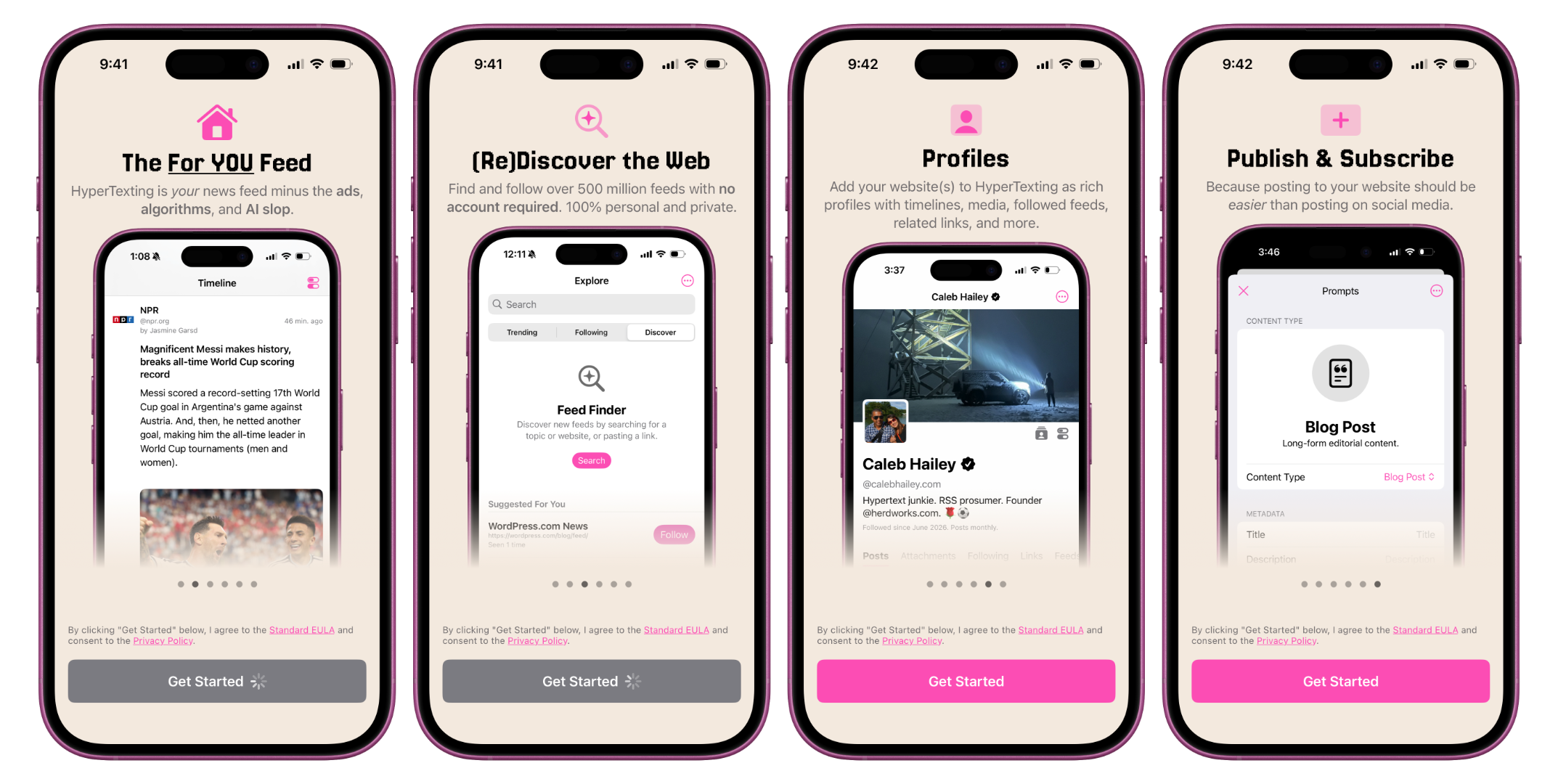
HyperTexting | HyperTexting is now available on the App Store
HyperTexting is now available to download on the App Store. See what's new in the public release.