 Caleb Hailey
@calebhailey.com
Caleb Hailey
@calebhailey.com
Anil Dash (@anildash.com) explains why "'Wherever you get your podcasts' is a radical statement" in simple terms:
Being able to say, "wherever you get your podcasts" is a radical statement. Because what it represents is the triumph of exactly the kind of technology that's supposed to be impossible: open, empowering tech that's not owned by any one company, that can't be controlled by any one company, and that allows people to have ownership over their work and their relationship with their audience.
By my count Anil uses the term "podcast" 22 times in this post. He never once mentions the technology that makes it possible: RSS enclosures.1 Anil is a fearless advocate for the open web. The omission of "RSS" is not a "dis" on open standards. He simply doesn't mention "RSS" because he doesn't have to. Celebrating the success of "podcasting" is inherently a celebration of the success of RSS! If Anil were to write a similar post about the enduring success of RSS, he might not mention HTTP or XML. Just like most posts you will read about HTTP won't mention TCP. I could keep going but I won't belabor the point.
I love the open web. One of the things I love most about the open web is that it's built from layer upon layer of open standard technologies. I especially love the products that not only adopt these technologies but go further and embrace the spirit of openness in the underlying standards. By giving creators and consumers more control and more choice over the way they experience the world wide web, they help to advocate for the open web.
Conversely, one of my least favorite things about the open web is when established voices attempt to suppress new ideas. That's the opposite of advocacy and it only hurts the open web. How does building an app based on the ideals of interoperation hurt the open standards? Conversely, how does criticizing new ideas that are designed to onboard new users to open standards actually help promote said open standards? 🤔
I love RSS. In fact, you could say I have demonstrated irrational dedication to RSS by quitting my day job and spending the last year of my life working on an app that adheres very closely to the RSS and OPML standards (among others). My goal with HyperTexting is to extend the reach of "RSS feed readers" beyond the group of people who have already known and loved them for the past 20 years. I just happen to think that the number of people who haven't tried an RSS feed reader is significantly larger than the number who have. And the group that hasn't tried RSS is made up of people who are overwhelmed with or intimidated by technology. HyperTexting is my experiment to try reaching that audience by focusing on the "why" of RSS (reclaiming control of your news feed) rather than the "how" (Really Simple Syndication as an open standard).
My theory is informed by graphs like this one:
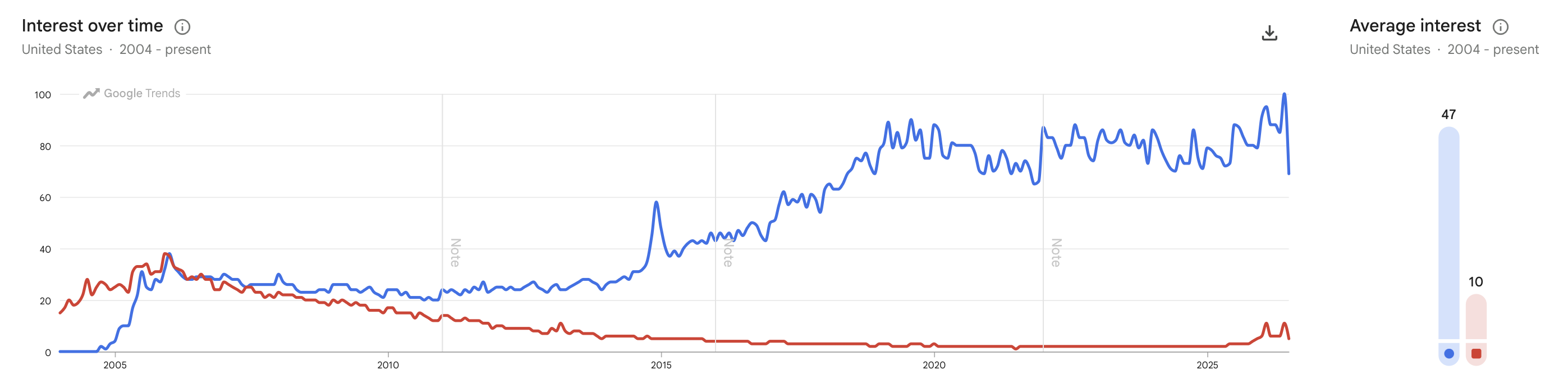
The blue line represents search activity for "podcast", and the red line represents search activity for "rss".
When I see this graph I see the growing success of RSS as a technology, even if the terminology itself is fading in popularity. I'm going to try my best to help and contribute to that success with some new ideas. I'm also going to ignore any gate-keeping criticism2 that freezes RSS in time and can only hurt its success.
-
see the original post by Dave Winer on thetwowayweb.com, via @web.archive.org. ↩︎
-
hi there, @doc.searls.com 👋 I know you read the footnotes, so here's a footnote just for you. I'm sorry you think my work is a "dis" on RSS, but you're welcome to your opinion. Everybody has one. 💩 I would however like to clarify that I have not once attempted to "re-brand RSS with [my] own app". I have only standardized on the term "feeds" instead of "RSS, Atom, and JSON Feed" (all three of which are supported by HyperTexting) in my app and marketing content. I have already documented the origin of the name HyperTexting and it has nothing to do with rebranding RSS. I have also not blamed anyone for the success of RSS, or suggested that there is "a stink on the standard." I don't know how you reached that conclusion when all I've attempted to do so far is "rally around conventions like Dave [Winer] is promoting with OPML blogrolls." I'm not the first person to suggest that there are still new ideas to be tried around RSS, and I'm already not the last. It's amazing that there are still opportunities (!) for RSS to continue growing after all these years. For my part I'm going to try to help them grow rather than criticize where that growth comes from. 🍻 ↩︎


Brunday – Doc Searls Weblog
• @doc.searls.comJust trying to make stuff happen