 Caleb Hailey
@calebhailey.com
The next major release of @hypertexting.com is now available in the App Store.
I'm excited about this one!
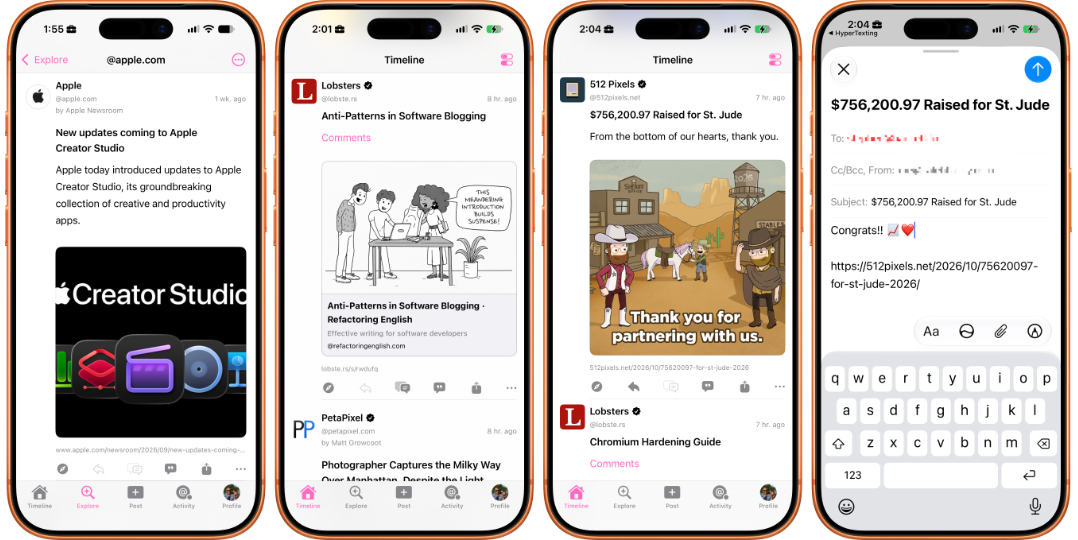

HyperTexting | Newsfeed Network Effects
• @hypertexting.comHyperTexting is your timeline minus the ads, algorithms, and AI slop. It's like the "for you" feed, but it actually works... for YOU (not the platforms).
Caleb Hailey
@calebhailey.com
HyperTexting.dev
Introducing @hypertexting.dev - the new home of the #HyperTexting CLI and developer documentation.


Introducing HyperTexting.dev
• @hypertexting.devMake Hypertext.
Caleb Hailey
@calebhailey.com
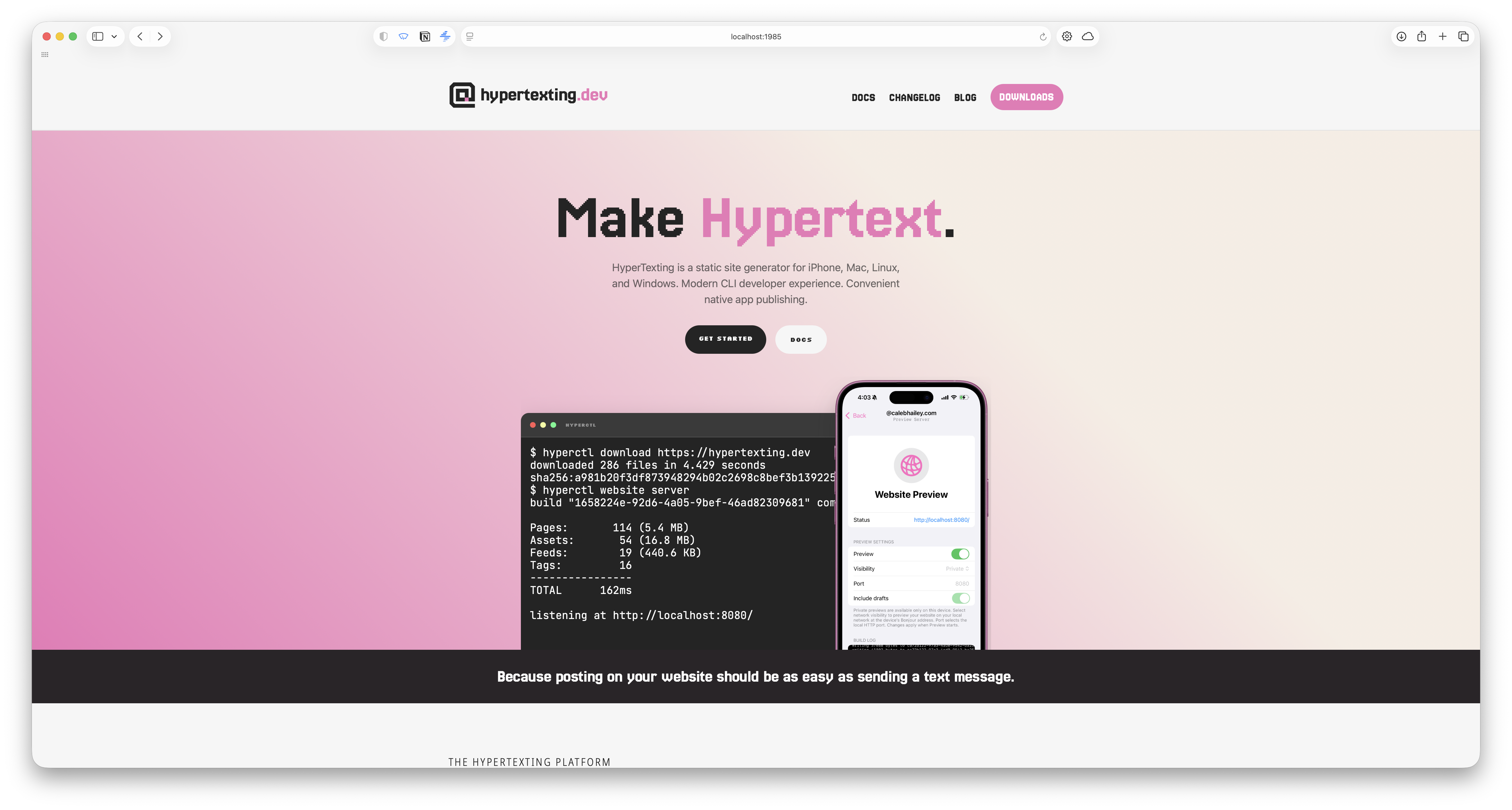
Sneak peek of the new @hypertexting.dev landing page (coming soon). 🚧
I feel like it's pretty unusual to place a terminal window alongside an iPhone screenshot. Is that intriguing or distracting? Does seeing an HTTP preview server running on iPhone pique your interest as a developer? Is it immediately recognizable as a static-site generator? 📐
Let me know: [email protected] 💬
 Caleb Hailey
@calebhailey.com
Spacefast
TIL about @spacefast.com, by @automattic.com.
Looks like another "publish first, sign up later" service, like Cloudflare Drop. I hate that it took AI agents to get us here, but I love that these exist now. This is going to be huge for @hypertexting.com.

Spacefast: Home for what your agent makes
• @spacefast.comPublish what you or your agent makes with Spacefast: share artifacts, host static sites, deploy web apps, manage versions, and use custom domains.
Caleb Hailey
@calebhailey.com
HyperTexting is not your grandpa's RSS reader.
🤓
HyperTexting
• @hypertexting.comHyperTexting is your timeline minus the ads, algorithms, and AI slop. It's like the "for you" feed, but it actually works... for YOU (not the platforms).
Caleb Hailey
@calebhailey.com
Whoa. I just submitted a new TestFlight build of @hypertexting.com, and it was approved in less than 60 seconds! 🤯
There's a new sheriff in town!! 🤠
Caleb Hailey
@calebhailey.com
I’m about to cut a new TestFlight release for @hypertexting.com after …checks calendar… 6+ weeks of work redesigning the SSG, profile manager, and composer. 🤯
There’s gonna be a lot to share over the next few weeks as I get this ready for App Store release. 🚀
Caleb Hailey
@calebhailey.com
Greg Wolanski (@gregwolanski.com) believes in [OPML] files:
I follow various websites using RSS. The list of sites I follow is a single OPML file that I can import to any RSS reader. Thanks to this single file, I don’t have to worry about being forced to use a specific app or painstakingly import my list of followed sites into a new one.
Subscription lists are an excellent example of the evergreen "File over app" principle by Steph Ango (@stephango.com), the CEO of @obsidian.md.
If you have ever exported your podcast subscriptions from a podcast app and taken them with you to a new podcast app, then you have very likely used an #OPML file.
Did you know that @hypertexting.com supports OPML file import and export, and podcast feeds? Just tap "Explore", then tap the "..." button and choose "Import feeds".


I believe in files
• @gregwolanski.com
Caleb Hailey
@calebhailey.com
Just submitted the first @hypertexting.com app update since the public launch. It’s full of fixes to issues reported by the initial wave of users, many of which were papercuts in the onboarding process. Hoping to get this through App Store Review before the next big press coverage and subsequent wave of new users! 🌊🌊
Caleb Hailey
@calebhailey.com
The chicken and egg of RSS and "podcasts"
Anil Dash (@anildash.com) explains why "'Wherever you get your podcasts' is a radical statement" in simple terms:
Being able to say, "wherever you get your podcasts" is a radical statement. Because what it represents is the triumph of exactly the kind of technology that's supposed to be impossible: open, empowering tech that's not owned by any one company, that can't be controlled by any one company, and that allows people to have ownership over their work and their relationship with their audience.
By my count Anil uses the term "podcast" 22 times in this post. He never once mentions the technology that makes it possible: RSS enclosures.1 Anil is a fearless advocate for the open web. The omission of "RSS" is not a "dis" on open standards. He simply doesn't mention "RSS" because he doesn't have to. Celebrating the success of "podcasting" is inherently a celebration of the success of RSS! If Anil were to write a similar post about the enduring success of RSS, he might not mention HTTP or XML. Just like most posts you will read about HTTP won't mention TCP. I could keep going but I won't belabor the point.


Brunday – Doc Searls Weblog
• @doc.searls.comJust trying to make stuff happen
Caleb Hailey
@calebhailey.com
Whoa. It's unbelievably cool to read about @hypertexting.com on @techcrunch.com! Thank you, Sarah, for your kind words!! 🙏


A new app, HyperTexting, turns the open web into a scrollable social media-like feed | TechCrunch
• @techcrunch.comTechCrunch | Reporting on the business of technology, startups, venture capital funding, and Silicon Valley
Caleb Hailey
@calebhailey.com
Blogrolls are a federated social network
I just stumbled upon a 2024 blog post by Robert Alexander (@alexsci.com) that offers a brief history of the blogroll and why it is still relevant today, in a post entitled "RSS blogrolls are a federated social network".
At its core a social network is a collection of links between users. The terminology varies, but these links could be friends, followers, subscribers, professional connections, etc. If we wanted to make RSS social, we’d need a way to define links between the feeds.
I like Robert's explanation that "An RSS feed is mostly just a list of posts" and that blogrolls as originally conceived in the early days of the web were "a list of hyperlinks to suggested websites". The problem is that there was never a similar convention for a list of feeds.
Discovering these blogroll links programmatically is challenging. Search engine crawlers can do it by exhaustively crawling the web, but the purpose of each hyperlink is unclear. There’s no specification for how to find a blogroll page or determine which hyperlinks are part of the blogroll. What’s missing is a specification for machine-readable blogrolls and a way to link to them from a homepage or RSS feed.
For as much time as I've spent on @opml.org, I don't know how I missed that Dave Winer (@scripting.com) already started promoting linking to OPML blogrolls from HTML and from a feed back in March 2024. I love it.
I continue to think that we need to talk about RSS without saying RSS (or "blogroll"), but in order to get there we will need to rally around conventions like Dave is promoting with OPML blogrolls.
My thanks to Robert for the helpful blog post. And to Dave for publishing a discoverable blogroll, where I discovered the @alexsci.com feed while browsing the @scripting.com profile in HyperTexting. 🤌
RSS blogrolls are a federated social network
• @alexsci.com
Caleb Hailey
@calebhailey.com
The social-media-like interface
There's a feeling you get when you are building something that you're very passionate about that can haunt you if you let it: "What if someone else makes something [similar / better / faster]?" It's a particular brand of imposter syndrome that will be familiar to anyone who has ever written1 an "Introducing X" blog post or tweet.
I just published one such blog post this morning, announcing the launch of @hypertexting.com for iPhone on the App Store. 🎉 It's exciting and scary at the same time. But it almost didn't happen.
I have never felt the aforementioned fear more acutely than this past January when Terry Godier (@terrygodier.com) published an essay called "Phantom Obligation":
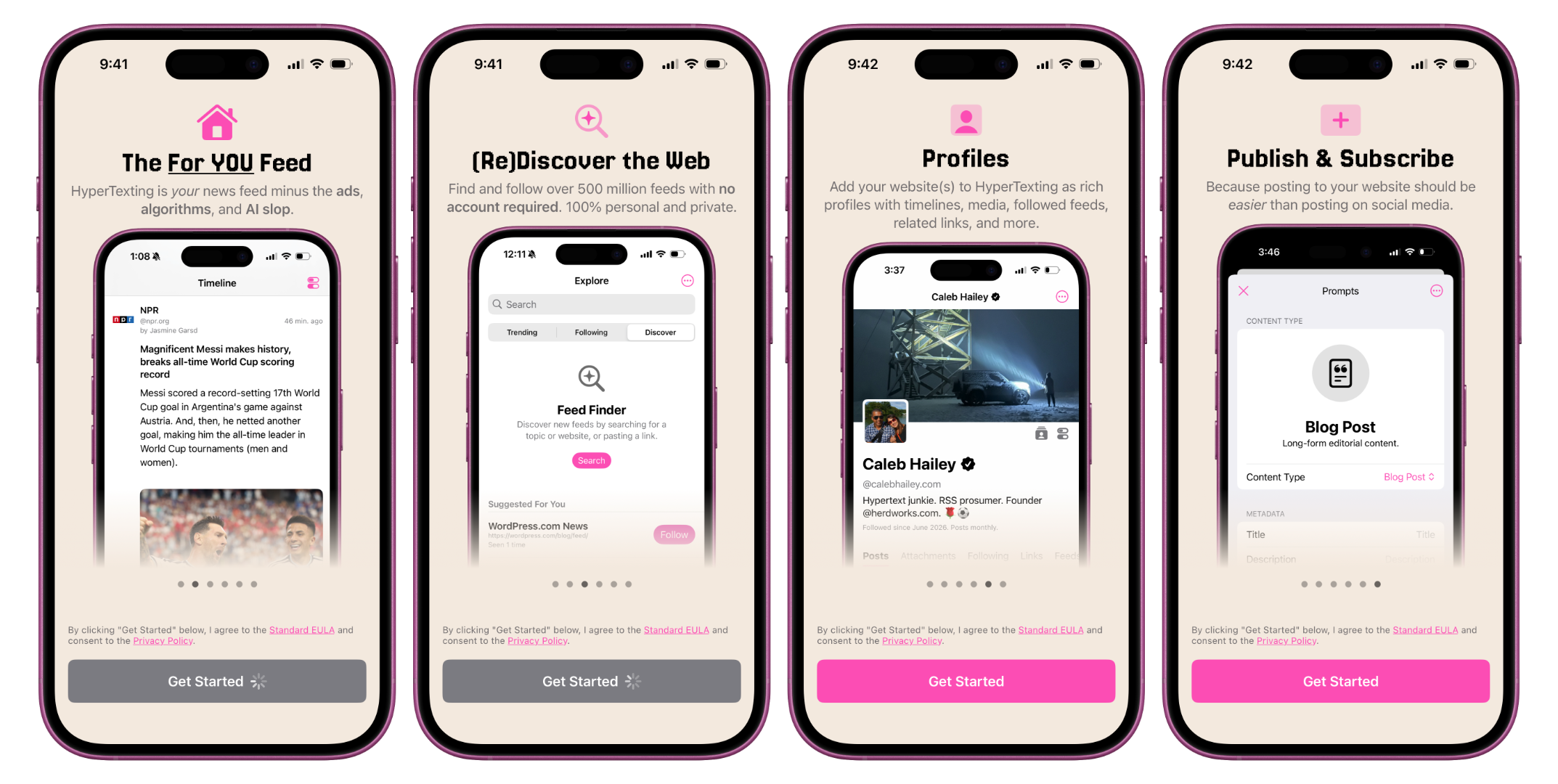
HyperTexting | HyperTexting is now available on the App Store
• @hypertexting.comHyperTexting is your timeline minus the ads, algorithms, and AI slop. It's like the "for you" feed, but it actually works... for YOU (not the platforms).
Caleb Hailey
@calebhailey.com
Legibility of Effort and The Social Contract of Writing
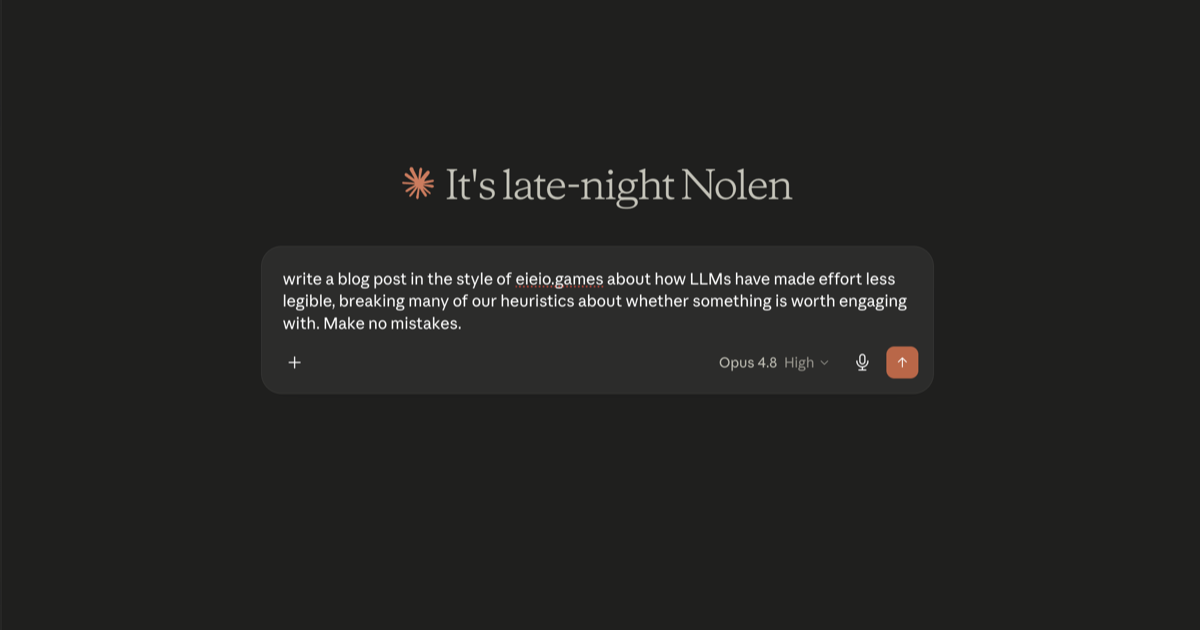
Nolan Royalty (@eieio.games), writing without the assistance of generative AI, in a post entitled "Legibility of Effort":
What software (and writing, to an extent) is missing now is legibility of effort - the ability to tell at a glance whether something took a human meaningful work.
First of all I cannot emphasize enough how much I appreciate that this was a blog post and not a tweet. The dense hypertextual writing in itself suggests some greater degree of effort. But as Nolan points out, even that isn't a trustworthy signal:
I wrote this blog post in my text editor. It took me a while.
Until recently, “someone cared enough to write this” was an ok heuristic. Plenty of writing on the internet was bad, but you could convince me that you cared about something just by writing it down.
Of course, generating plausible-looking text - or a plausible-looking website - is trivial now.
This reminded me of a post I bookmarked last week by Johanna Larsson (@jola.dev), entitled "The Social Contract of Writing", and the @oxide.computer Request For Discussion document RFD 576 that Johanna linked to:
LLM-generated writing undermines the authenticity of not just one’s writing but of the thinking behind it as well. If the prose is automatically generated, might the ideas be too? The reader can’t be sure — and increasingly, the hallmarks of LLM generation cause readers to turn off (or worse).
Finally, LLM-generated prose undermines a social contract of sorts: absent LLMs, it is presumed that of the reader and the writer, it is the writer that has undertaken the greater intellectual exertion. (That is, it is more work to write than to read!)
I love this "social contract" framing. I've been think about this in terms of the difference between writing for a social media platform versus writing for a website (e.g. a blog post). When content is written for social media, I automatically assume that less effort was put into the writing because less care was put into the longevity and accessibility of the writing. When is the last time you read a month-old tweet? If you did I bet it was embedded in or linked from a blog post, where writing is generally meant to last. And if someone doesn't care about their writing enough to put it somewhere durable, then why should I take the time to read it? Was it posted on social media primarily for the engagement? The likes and retweets and hot takes from people who only read skim the introduction, or who are replying in the comments to try and steal some of the fleeting attention the original post is getting? Conversely, the only way to reply to most of the serious effort writing I read is via email. Writing that can only be replied to by email says something. A writer who wants to avoid effort doesn't knowingly invite the general public to fill their inbox.
Back to Nolan's post, where he concludes:
For me, this means it’s harder to find good stuff worth engaging with online. And on a larger scale, systems built on easily gauging effort at a glance are falling apart.
I think there's more good stuff worth engaging with online than there ever has been. Good stuff that people worked hard to create1. I don't think that content is harder to find than it was before, I just think you're not going to find it in on social media platforms where the algorithms don't care about effort.
Social media platforms are enormous systems full of mixed effort content. Gauging that effort at a glance has always been necessary to find the good stuff. Social media will probably never fall apart, but I do think the value proposition of social media has a crack in the foundation. Fortunately, I think the path to (re)discovering the good stuff is just a hyperlink away, via the destination internet.
-
even if the good stuff is made with the help of AI, as Nolan concedes, "Making a good thing still requires making lots of decisions, and making lots of decisions is still very hard, despite LLMs, so making good things is still very hard." ↩︎

Legibility of Effort · eieio.games
• @eieio.gamesgames, writing, and nonsense from nolen royalty
Caleb Hailey
@calebhailey.com
Updated the first-launch experience in @hypertexting.com while I wait on App Store Review.
Caleb Hailey
@calebhailey.com
Just submitted a public release candidate of @hypertexting.com for App Store Review. 😱
Time to start recording some demo videos and writing some blog posts! 🚀
Caleb Hailey
@calebhailey.com
Started working on background refresh in @hypertexting.com (finally) and it’s coming together pretty nicely!
The pull-to-refresh gesture feels MUCH faster now. The timeline tab shows a counter when new posts are available.
Coming soon to #TestFlight! 🚀
 Caleb Hailey
@calebhailey.com
This is a test post from the @hypertexting.com composer! Coming soon to #TestFlight 🚀
Caleb Hailey
@calebhailey.com
Putting humpty together again
I've been on a long hiatus from posting here while building @hypertexting.com. I've been chipping away at a refresh to my personal website ever since the HyperTexting public TestFlight kicked off, so it feels good to finally have the first batch of changes deployed.
Time to start building in public! 🚀
Caleb Hailey
@calebhailey.com
Setting up my HyperTexting… 🤌